Do Glucose Readings Under 110 Lead to Damage
Get new posts by e-mail or rss feed
Disclaimer: This experiment was only washed on one person (myself) and is not fully randomized, placebo controlled, or blinded. Please take all conclusions with the advisable skepticism.
Summary
Vitamin C is reported to falsely raise blood glucose readings in both fingerstick and continuous glucometers. I wanted to know if this was something that I (and others) should be concerned about, but all the reports I found were for intravenous vitamin C and I couldn't get any data from the CGM companies.
To get an answer, I tested information technology myself, monitoring blood glucose afterward ingesting 2-6g of vitamin C, twenty-threescore the FDA recommended daily corporeality (just known to be safe). I did not observe whatever consistent or sustained increment in blood glucose, so I conclude that ingested vitamin C has no measurable impact on my blood glucose measurements at any applied quantity.
Details
Groundwork
When I first tried out the FreeStyle Libre CGM, I read through the manual and noticed an unusual warning:
"Taking ascorbic acid (vitamin C) while wearing the Sensor may falsely enhance Sensor glucose readings. Taking salicylic acrid (used in some pain relievers such as aspirin and some skin care products) may slightly lower Sensor glucose readings. The level of inaccuracy depends on the amount of the interfering substance active in the body."
Vitamin C is an essential food and present in tons of foods and most multivitamins. If it falsely raises glucose readings, that's a huge flaw in the device.
I tried contacting Abbot, who confirmed that vitamin C can cause erroneously loftier glucose readings, but couldn't point me to any studies or say how strong the effect was. I also contacted Dexcom and there support rep. said that "Vitamin C was not contraindicated for Dexcom CGMs," but again couldn't indicate me to any studies or say if they had or hadn't run whatever tests.
Having failed at getting useful info directly from the CGM companies, I turned to the published literature. I found a number of reports of Vitamin C leading to high claret glucose readings (ane, 2, 3, iv, five; not exhaustive, at that place are many more than). From these, I learned the following:
- All reports in scientific or medical journals were for patients taking intravenous vitamin C.
- Vitamin C can be oxidized by glucose oxidase and glucose dehydrogenase, the enzymes used to find glucose in most portable glucometers, including almost fingerstick meters and both the FreeStyle Libre and Dexcom CGMs
- The increment in reported blood glucose can exist extremely big; one time a women read 343 mg/dL on standard glucometer, while a blood test showed her actual blood glucose as 49 mg/dL.
- The blood levels of vitamin C in these reports were extremely high, 1,000 – 5,000 µmol/L. This is much higher than the 100-200 µmol/L observed with regular oral vitamins.
- There's only one anecdotal report on a diabetes forum of someone who saw loftier CGM readings after taking oral vitamin C, with numerous comments from people claiming that they exercise not see this.
Given all this, information technology seemed unlikely that regular consumption of vitamin C would significantly impact blood glucose readings, but I was left with two questions:
- Was there whatever measurable effect of ingested vitamin C, fifty-fifty if small?
- Would mega-doses of vitamin C accept a significant outcome?
- mega-doses of vitamin C were advocated past Linus Pauling (nobel prize winner in chemistry). His theory has since been debunked, but is unfortunately nevertheless used past many people.
Since I couldn't notice any direct studies of the outcome of ingested vitamin C, I decided to practice my ain experiment.
Purpose
To quantify the effect of ingestion of vitamin C in blood glucose readings from Dexcom G6 and Freestyle Libre CGMs.
Design/Methods
Process. At selected times of day, 2, four, or 6g of vitamin C was ingested and blood glucose monitored using a continuous glucose monitor.
Measurements.Blood glucose was measured using a Dexcom G6 CGM and FreeStyle Libre fourteen mean solar day CGM.
Data Processing & Visualization.Data was visualized using Tableau.
Medication. I took my normal morn, evening, and meal medications.
Data
set1, set2
Results & Word
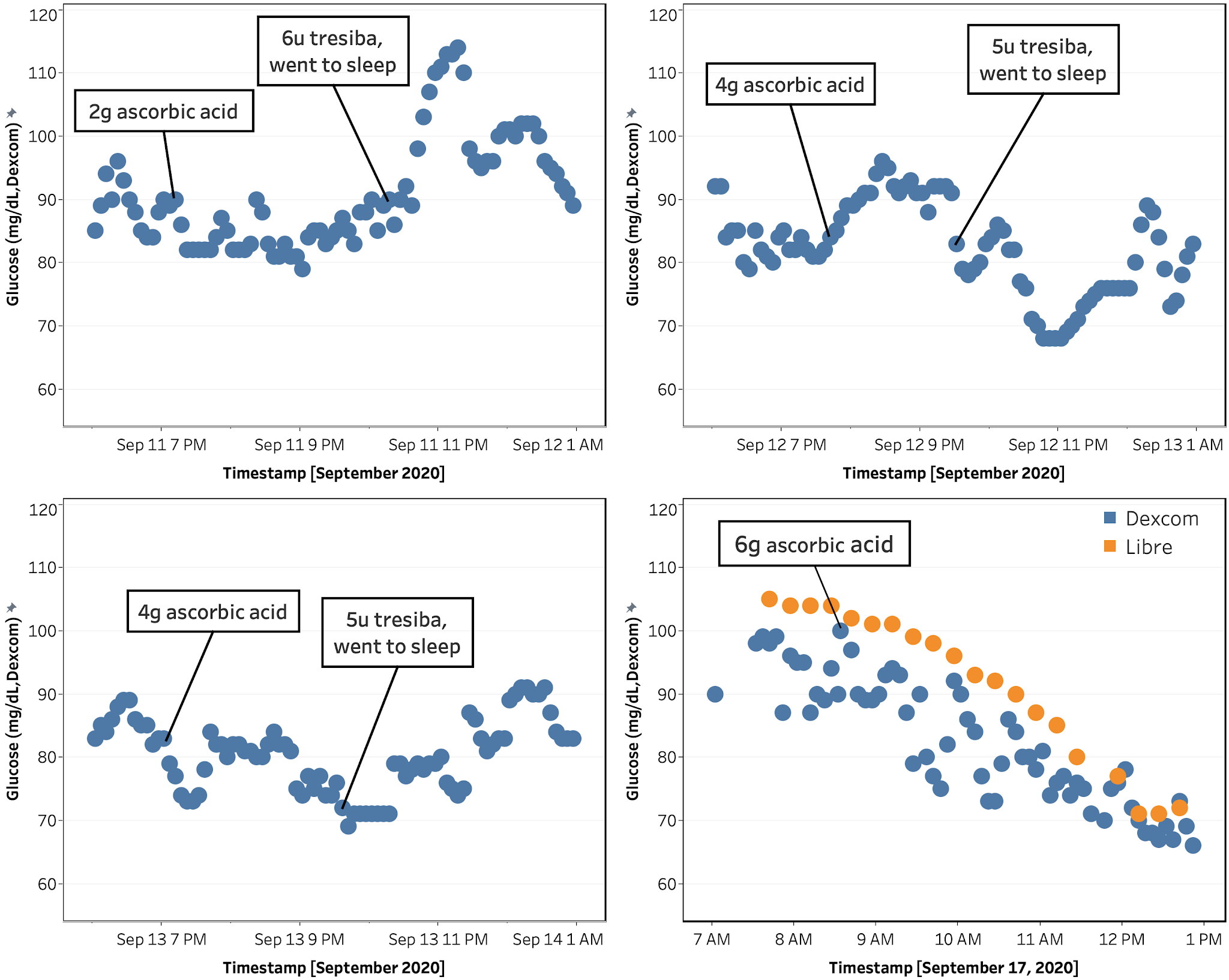
According to the NIH, the recommended corporeality of vitamin C is 65-90 mg/day and the tolerable upper limit is 2,000 mg/mean solar day. However, studies take shown no serious adverse furnishings at much higher amounts and >x,000 mg/solar day is prescribed for handling of certain cancers with no ill effects. Given that data, I tested ingestion of two,000, 4,000, and 6,000 mg of vitamin C.
As tin can be seen in Figure 1, there was no significant rise in measured blood glucose in whatsoever of the four experiments that could be attributed to vitamin C intake. While here were transient increases in measured blood glucose in the first three measurements, they were non consistent in time or magnitude. In addition, all the reports of increases from intravenous vitamin C indicated that the result was of long-duration (such that measured blood glucose was still elevated well after the patient arrived at the hospital or clinic).
Based on this data and the fact that typical vitamin C consumption is much less than what I took in these experiments, I conclude that ingested vitamin C has no measurable impact on blood glucose measurements at any practical quantity.
Final Thoughts & Next Experiments
This was a very satisfying experiment. Pretty quick, answered a question I wasn't able to notice in the literature or from the CGM companies (though they probably knew the respond), and results were very clear.
Adjacent up:
- Re-tune basal and bolus (meal) insulin doses
- My routine has inverse a lot due to working from home, irresolute doctors, and changing medication (due to insurance requirements). Plus, I was able to get a Dexcom G6 CGM, which is showing accuracy comparable to my blood glucose meter. Blood sugars are still practiced, but I recollect I can become them improve.
- This is going pretty well. As I expected, I had my basal:bolus ratio off. I'm steadily getting it corrected and information technology'southward making my blood saccharide a lot more stable.
- Re-measure out claret sugar impact of glucose and insulin; compare to previous data
- While working from abode, I've gained some weight (and hopefully muscle). This has resulted in a change in my insulin sensitivity. Not huge, merely I need to remeasure to have an authentic baseline for futurity experiments.
- Test the consequence of some dietary supplements that have been reported to affect blood carbohydrate in the literature, merely where data bereft or contradictory
- Glutamate (reported to reduce mail-prandial glucose, but magnitude and timing vary widely)
- Others tbd.
As always, if you have any questions, comments, suggestions, or are interested in joining in future experiments, please let me know in the comments or transport a PM via the contact class or to quantifieddiabetes_at_gmail.com.
– QD
Become new posts by e-mail or rss feed
Source: https://www.quantifieddiabetes.com/2020/09/does-vitamin-c-really-cause-false-blood.html
0 Response to "Do Glucose Readings Under 110 Lead to Damage"
Post a Comment